


















Light Knows Where It's Welcome: Choosing the Right Laser Wavelength for Your Sensing Environment
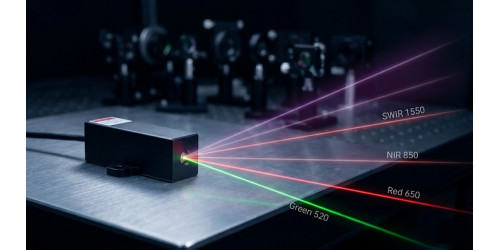
You've selected a laser module. The power is right, the beam shape is clean, the form factor fits your enclosure. Then you deploy it outdoors — and the range drops by half in rain. Or you aim it into a liquid-filled tank and get no meaningful reflection. Or it works beautifully in the lab and performs inconsistently in a dusty production environment. None of these are hardware failures. They're physics.
The interaction between laser light and the environment it travels through is not random — it follows very predictable rules, and those rules are determined largely by one parameter: wavelength. Understanding how different wavelengths behave in water, atmosphere, and other media isn't just academic. It's the difference between a product that works in the field and one that works only on your bench.
Let's unpack this, wavelength by wavelength.
For most outdoor or industrial laser applications, water is the dominant environmental factor you'll encounter — whether that's literal submersion, rain, fog, humidity, or a process liquid you're trying to measure. Water molecules interact with photons in ways that are highly wavelength-dependent, governed by the molecule's vibrational and rotational energy modes.
The practical consequence: a wavelength that travels freely through air might be completely absorbed within millimeters of entering a water body, while another wavelength can propagate tens of meters underwater. Getting the wavelength wrong means designing a product that the physics simply won't cooperate with. It's also important to note that these interactions are dynamic — factors such as water temperature, salinity, and the presence of suspended particles can further shift the absorption spectrum and impact overall performance.
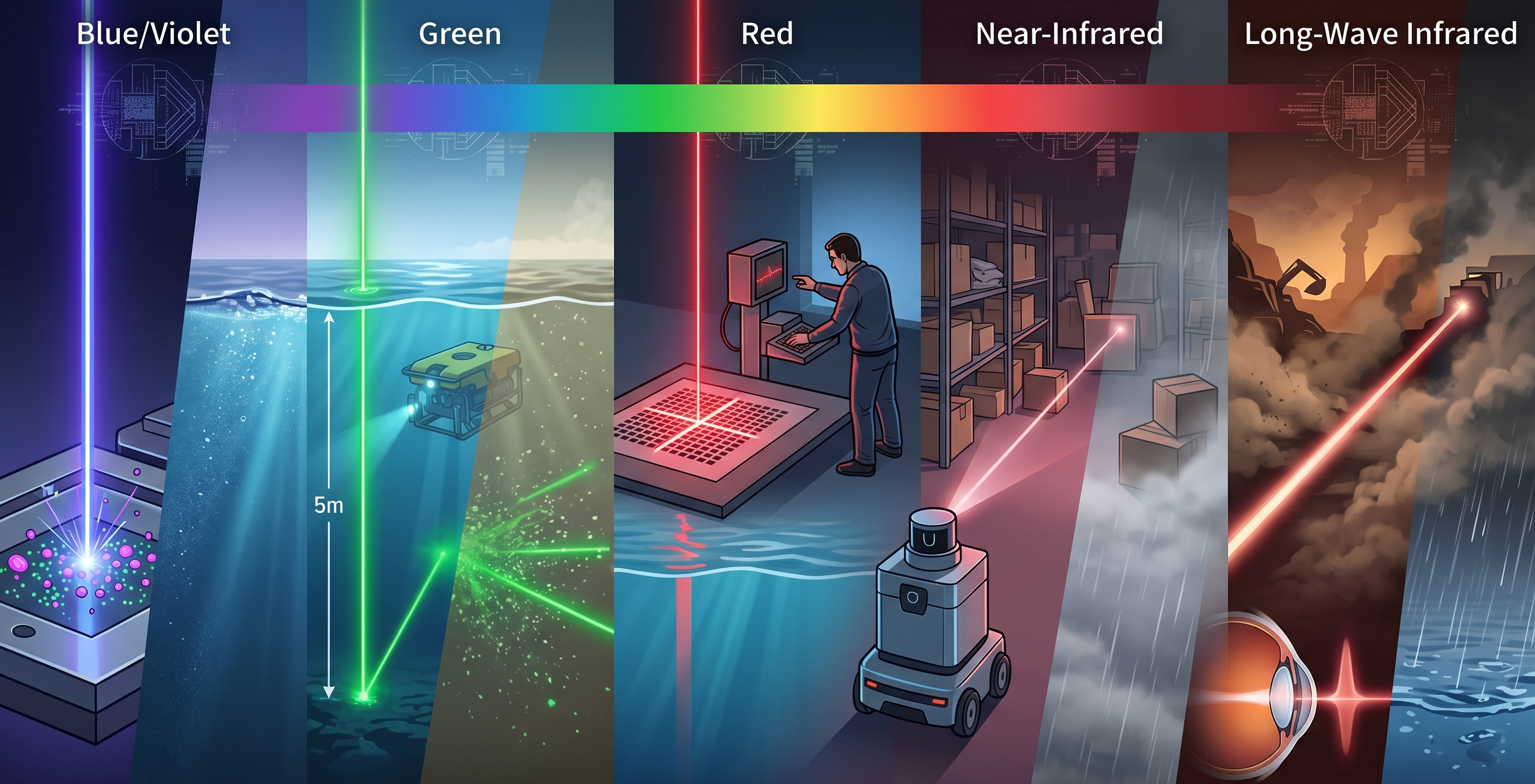
Here's how the common laser wavelengths compare, from blue-violet to the short-wave infrared.
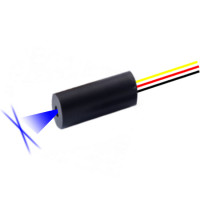
In pure water, 405nm absorption is relatively low — comparable to 520nm in clean conditions. Performance degrades significantly when the water contains dissolved organic matter or other chromophores, where absorption at this wavelength rises sharply. This makes 405nm viable for some underwater fluorescence imaging and inspection applications in clean-water environments, while performing poorly in biologically active or organic-rich water.
Where 405nm shines is in applications where you want interaction, not penetration. It is commonly used in biomedical and industrial inspection applications, where the short wavelength provides high spatial resolution. In industrial contexts, it appears in UV-adjacent marking, curing, and fine-scale inspection systems.
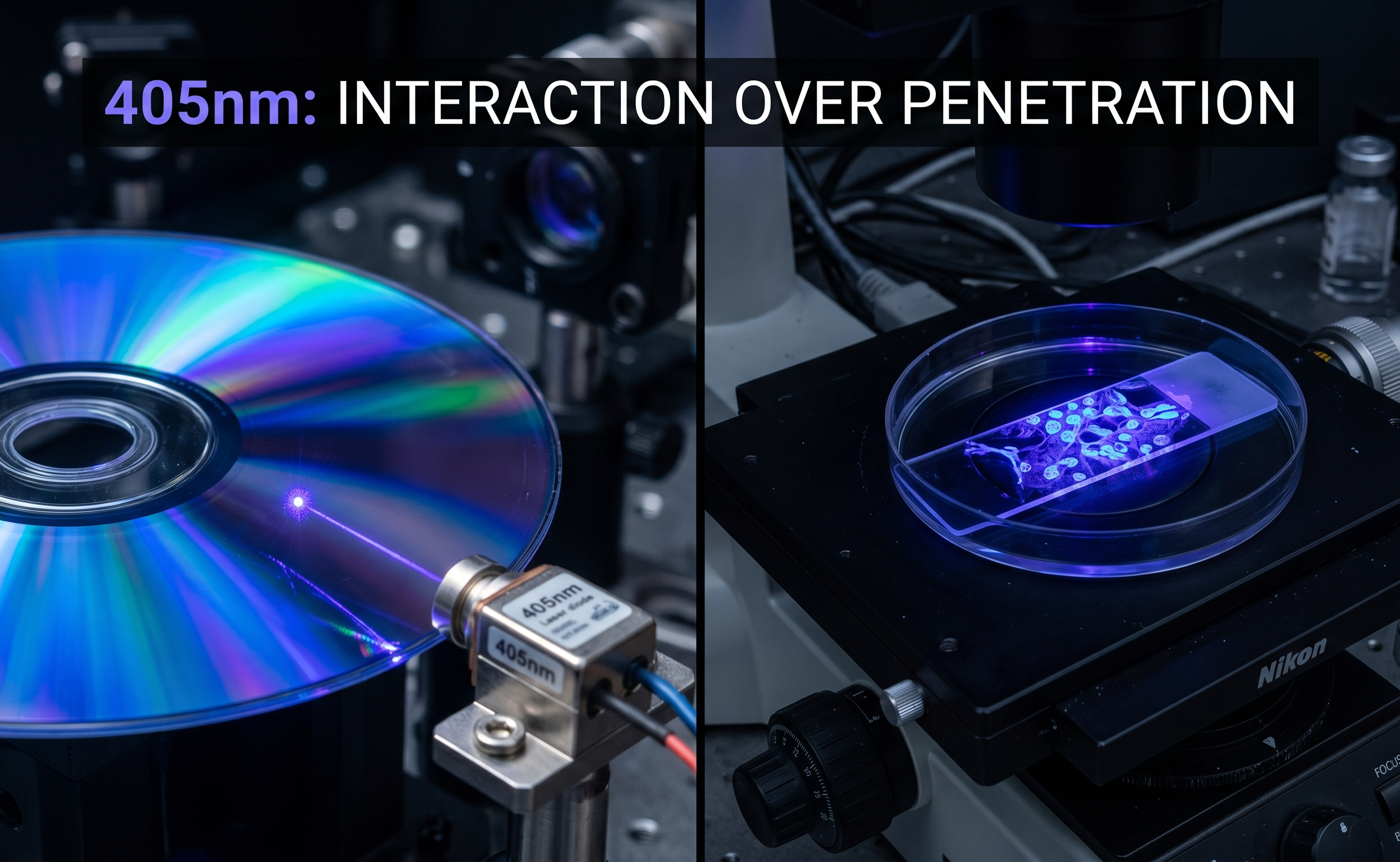
One worth knowing: 405nm is also the wavelength used in Blu-ray optical systems — where its short wavelength enables much finer data pits than the 780nm used in CD players. It's not a sensing workhorse in outdoor environments, but when the application calls for its resolution, there's no substitute.
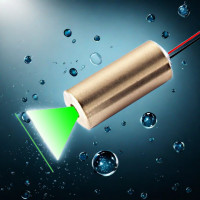
This is where things get interesting for water-based applications. Water's absorption spectrum has a broad region of low absorption in the blue-green portion of the visible spectrum — and 520nm (green) sits comfortably within this transmission window. Water absorbs green light relatively weakly compared to both shorter visible wavelengths and the near-infrared, which means green lasers can propagate through clear water for tens of meters before being significantly attenuated.
This is not coincidence — it's why the ocean appears blue-green rather than red or yellow. The physics that colors the ocean is the same physics that makes a 520nm laser useful for underwater ranging. In open-air outdoor sensing, however, 520nm is not the primary choice: higher module costs, visible-beam safety management requirements, and inferior range performance compared to NIR make it a specialist tool for water-based applications specifically.
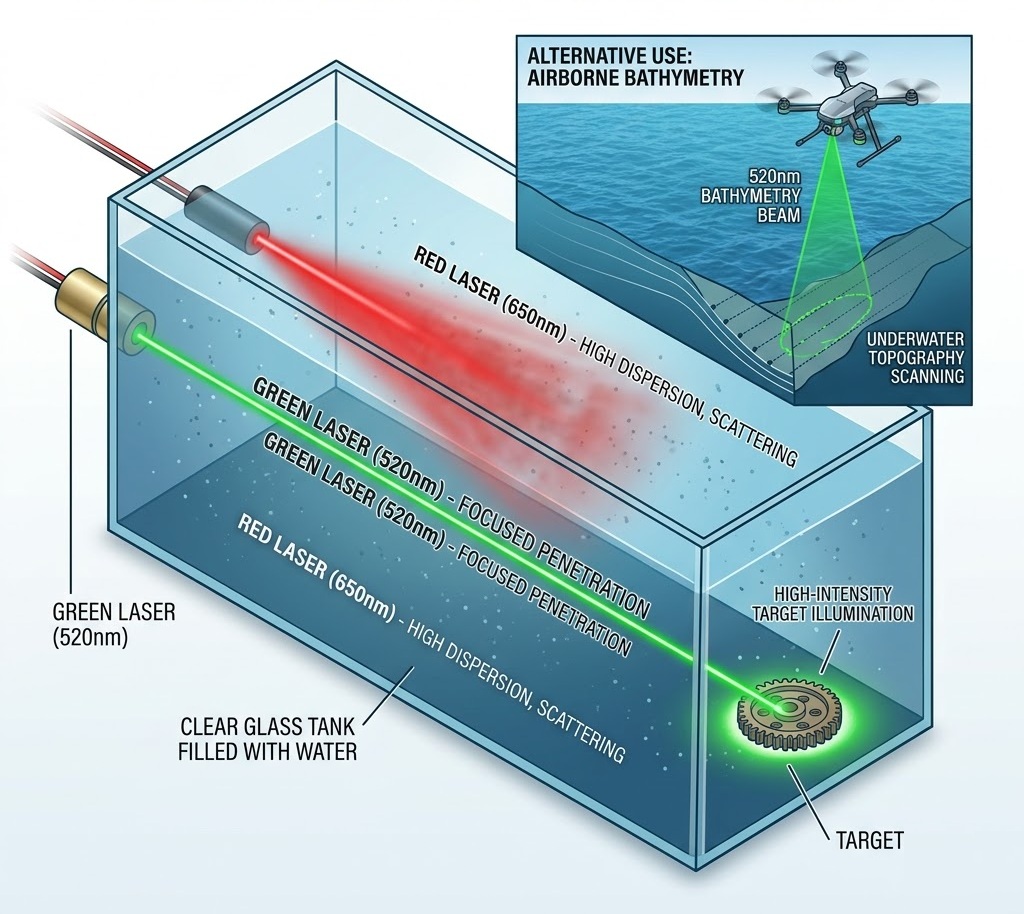
Practical applications of 520nm:
- Airborne Bathymetry: Aircraft-mounted LiDAR systems use green lasers to map the seafloor in coastal areas. The laser pulse passes through the air-water interface and reflects off the seabed; depth is calculated from the time delay between the surface reflection and the bottom reflection.
- Underwater Inspection: Green laser modules in ROV systems or inspection probes can illuminate and image objects at distances where white-light illumination would be overwhelmed by backscatter.
- Pipe and Tank Inspection: For water-filled pipes or clear-liquid tanks, green laser ranging can provide non-contact distance measurements.
- Drone-based Coastal Mapping: Increasingly used for environmental monitoring of reef systems, sediment transport, and shoreline change detection.
The practical limitation is that 520nm performance degrades rapidly with water turbidity — suspended particles scatter and absorb light and shorten the effective range. In clear ocean water, tens of meters is achievable. In murky harbor water or sediment-heavy rivers, that figure shrinks considerably.
Red light at 650nm sits in a unique part of the spectrum. In many practical scenarios — especially in clear shallow water — water absorbs it less than it absorbs near-infrared wavelengths, making 650nm a viable option for clear-water path applications where signal clarity and reflection strength are important. While 520nm is often cited for maximum depth in pure water, 650nm remains a strong choice where depth requirements are moderate and system visibility during setup and calibration is useful.
In air, 650nm is the bread-and-butter wavelength of laser pointer modules, barcode scanners, and short-range alignment systems. It is visible to the human eye, low in cost to produce, and safe at typical consumer power levels. It is also commonly used in plastic optical fiber (POF) communication over short distances, and in medical applications such as photobiomodulation therapy.
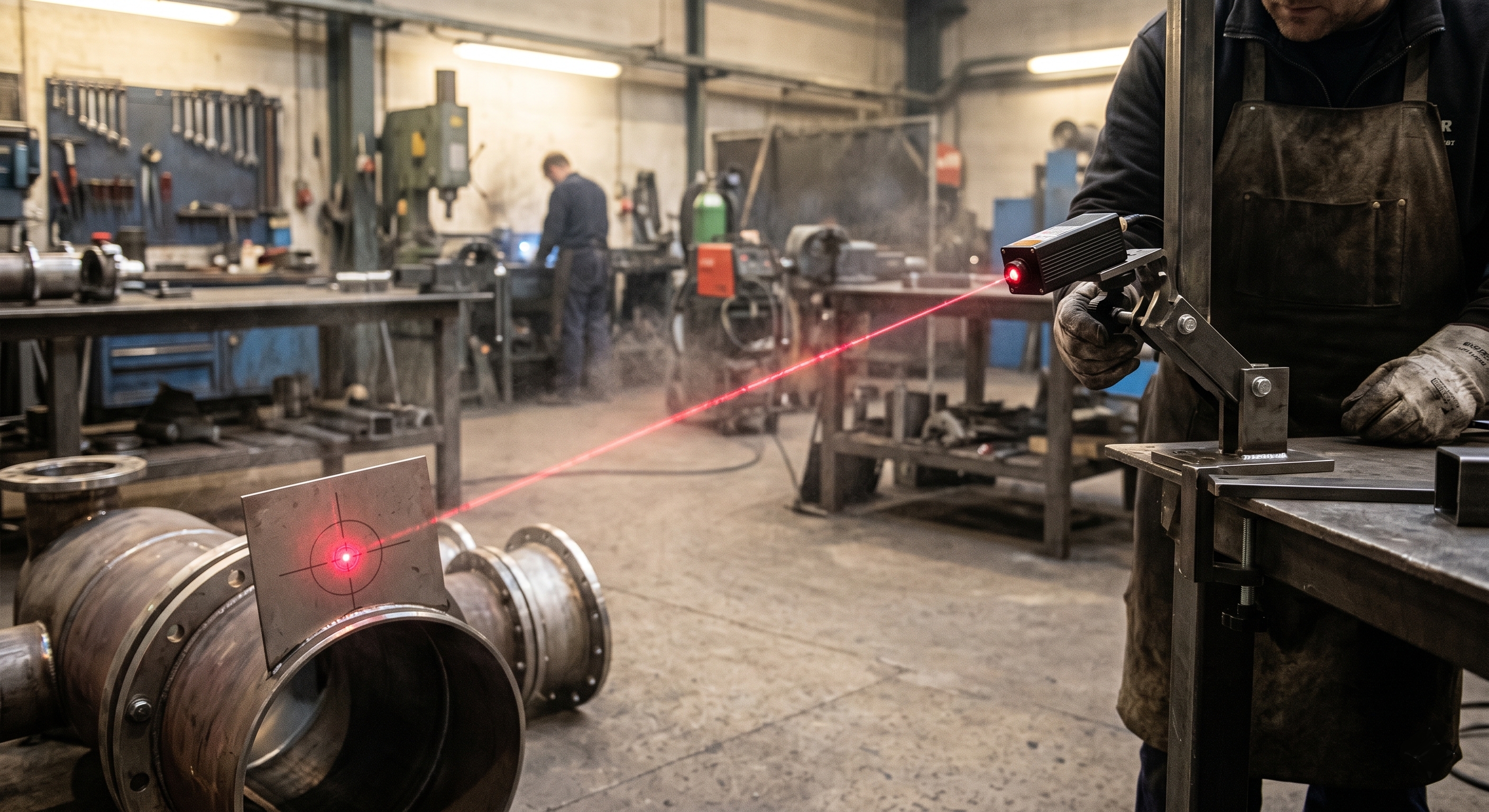
For industrial sensing in water or process liquids, 650nm deserves consideration when the depth is modest and system visibility is helpful. For longer-range outdoor sensing, it yields ground to 905nm on both range performance and all-weather robustness.
At 905nm, water absorption rises significantly compared to the visible range — making 905nm ill-suited for underwater propagation, but well-matched to the requirements of outdoor air-path sensing. In the atmosphere, 905nm sits in a region of low absorption and relatively low Rayleigh scattering, making it an efficient choice for outdoor ranging.
It is the dominant wavelength for automotive LiDAR and time-of-flight sensors for several practical reasons:
- Silicon photodetectors — cheap, mature, and widely available — are still sensitive at 905nm, keeping system costs manageable.
- The wavelength is invisible to the human eye, avoiding visual distraction.
- Atmospheric transmission is good across a wide range of weather conditions.
- At the power levels used in typical 905nm LiDAR systems, a Class 1 eye safety classification under IEC 60825-1 is achievable without exotic beam management.
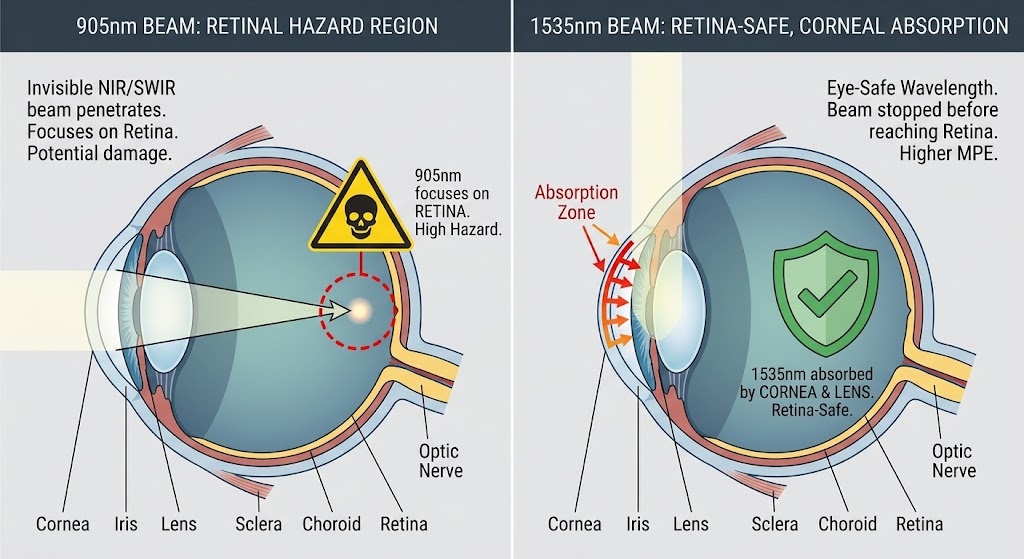
The eye safety point deserves nuance. 905nm falls within the retinal hazard region (400–1400nm) — light at this wavelength does reach the retina. Achieving a safe classification requires keeping peak power and pulse duration within IEC 60825-1 limits, which constrains how much energy a 905nm LiDAR can emit per pulse. This, in turn, sets a practical ceiling on its maximum range without advanced detection techniques.
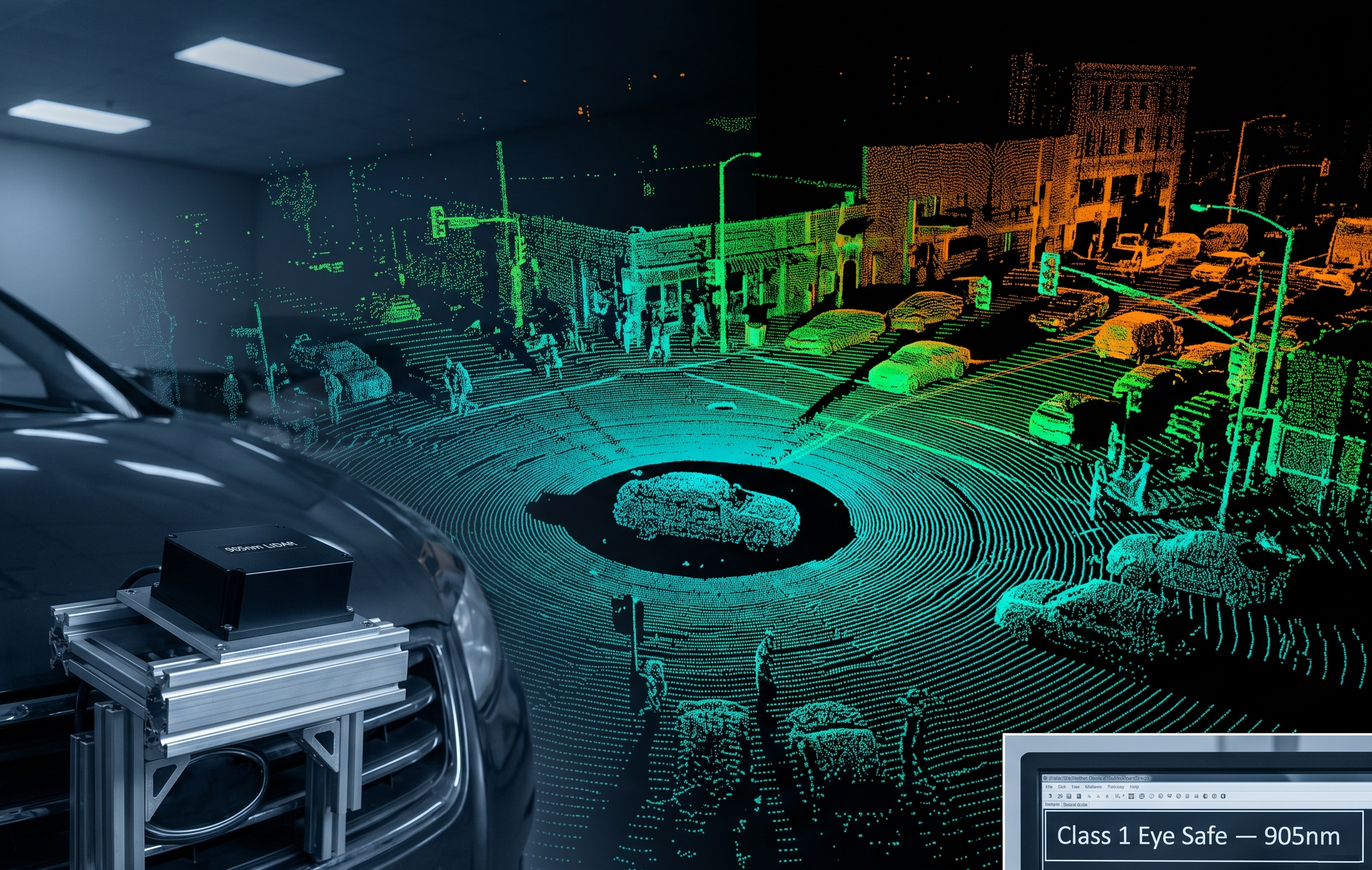
In fog and rain, 905nm performs adequately for automotive-grade conditions. It handles moderate weather within the ranges required for ground vehicle applications — typically up to around 100–200m — which is why it remains the cost-effective default for most terrestrial sensing designs.
This is where the physics becomes genuinely remarkable — and the reason 1535nm is the standard for long-range laser rangefinders and military-grade LiDAR.
The key is eye safety, but the mechanism is worth understanding precisely. Wavelengths longer than approximately 1400nm are absorbed by the cornea and lens of the human eye before they can reach the retina. Since the retina is the light-sensitive tissue where permanent laser damage occurs, anything that stops the photons before they reach it is a significant safety advantage. This is why wavelengths above ~1400nm are classified as retina-safe — and why the Maximum Permissible Exposure (MPE) for 1535nm under IEC 60825-1 is dramatically higher than for 905nm. Systems can operate at significantly greater pulse energies while remaining in a safe classification. This is what enables 1535nm rangefinders to reach ranges of several kilometers that would be impractical or unsafe at 905nm.
A few important points to keep accurate here:
- The technology behind it: 1535nm is typically generated by Erbium-doped glass (Er:Glass) lasers or Erbium-doped fiber systems. This is more expensive than the gallium arsenide diodes used at 905nm, which is why 1535nm systems carry a higher price point and are less common in consumer applications.
- What 1535nm is not good at: Water absorption. The same molecular property that makes 1535nm retina-safe also makes it sensitive to liquid-water environments — heavy rain attenuates the beam, and performance in water-filled paths is poor. For applications where precipitation resilience is critical at short to medium range, 905nm remains the more weather-robust option.
- What 1535nm does particularly well in: Dust, smoke, haze, and aerosols. The longer wavelength interacts less with small particles (Mie scattering scales with the ratio of particle size to wavelength), maintaining cleaner signal propagation in dirty atmospheric conditions — construction dust, desert environments, mining operations, or industrial exhaust.
- The stealth factor: 1535nm is beyond the detection range of standard silicon-based night-vision equipment, which typically responds up to around 1000–1100nm. For defense and high-security applications, this means a 1535nm ranging system does not appear as a visible beacon to observers using conventional night-vision optics.
A reasonable question after reading the above: if green light penetrates water better than NIR, why don't outdoor LiDAR systems use 520nm?
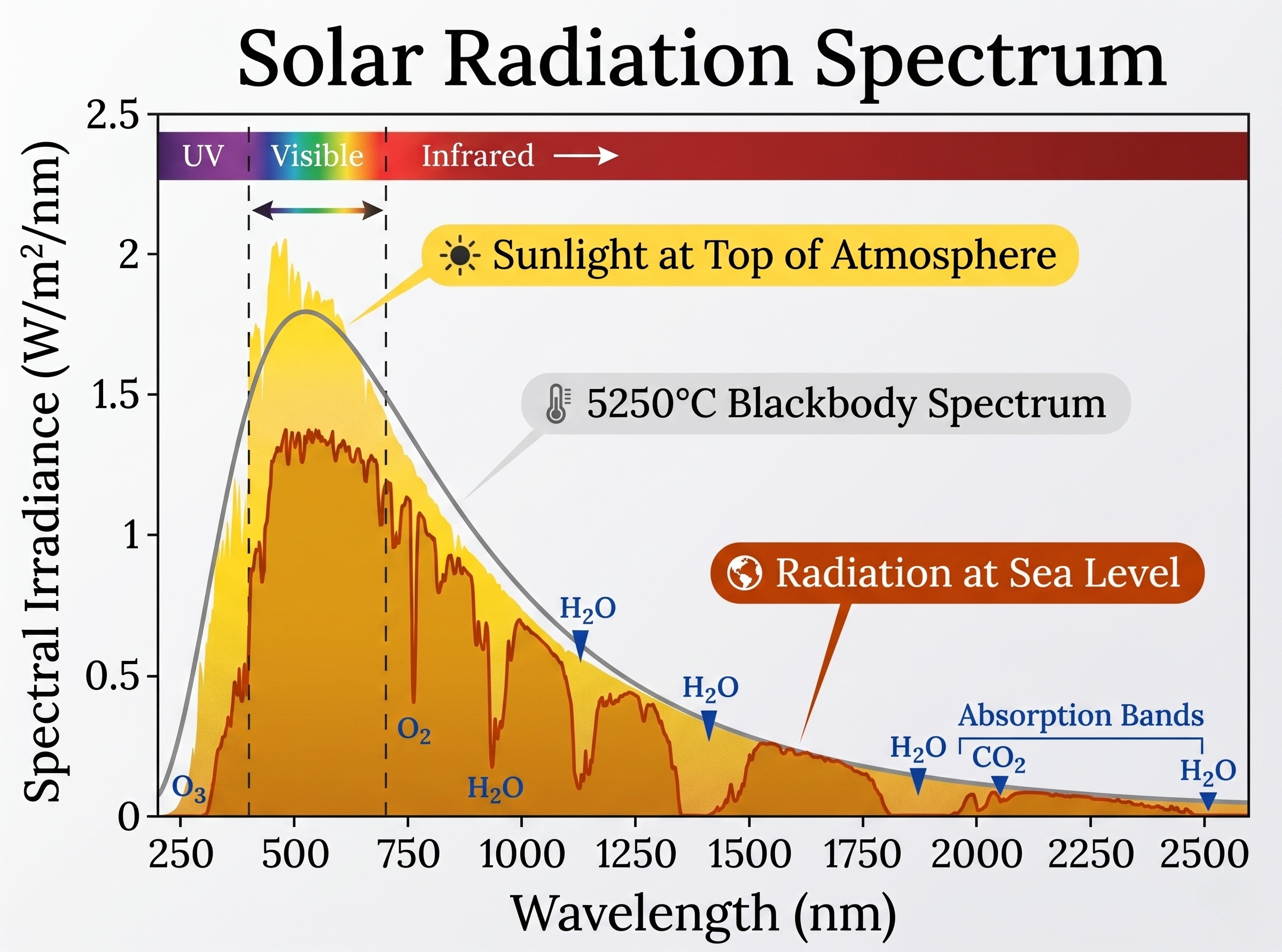
The answer starts with the sun. Sunlight is the dominant noise source for outdoor photodetectors — it saturates receivers and buries weak return signals. Fortunately, the solar irradiance spectrum at ground level is not uniform: the atmosphere, water vapor, and oxygen create distinct absorption bands that produce relative minima at certain wavelengths. Both 905nm and 1535nm fall within regions where ground-level solar irradiance is comparatively low, reducing background noise at the detector and improving signal-to-noise ratio. The visible range — including 520nm — sits in the peak of solar output, which is precisely why it is effective for underwater applications (the ocean's biosphere evolved around that light) but a poor choice for outdoor ranging against a sunlit background.
Beyond the solar noise argument, 1535nm offers a further advantage over 905nm for very long-range applications: its higher permissible output power, enabled by eye-safe classification, allows greater pulse energy and therefore greater detection range — particularly beyond 4 km, where 905nm systems reach their practical ceiling. The trade-off is cost: Er:Glass or fiber-based 1535nm sources are considerably more expensive than the silicon-detector, GaAs-diode systems used at 905nm. Green LiDAR does exist, but as a specialist tool exploiting its water penetration property — not as a general-purpose outdoor ranging solution.
Ultimately, wavelength selection for outdoor LiDAR is an exercise in balancing solar background rejection, permissible output power, range requirement, and system cost. 905nm wins on cost and supply-chain maturity for short-to-medium range; 1535nm wins on range capability and eye safety for long-range and defense applications. The physics informs the budget; the budget informs the design.
The table below summarizes how each wavelength performs across the dimensions that matter most to product engineers. Use it as a starting point for narrowing your options — then follow the decision prompts beneath it to match your specific application.
| Property | 405nm Blue-Violet |
520nm Green |
650nm Red |
905nm NIR |
1535nm SWIR |
| Water Absorption | Low | Low | Medium | High | Very High |
| Atmospheric Use | Limited | Limited | Limited | Good | Excellent |
| Key Advantage | High resolution precision applications | Underwater applications | Cost-effective solutions | Outdoor environments, cost-effective, long-range | Outdoor environments, eye-safe, ultra-long-range |
| Key Limitation | Not suited for outdoor use | Not suited for outdoor use | Not suited for outdoor use | Peak power limited by retinal safety | High cost; unsuitable for rain or high-humidity environments |
Quick Application Guide
- Need to see underwater? Think 520nm (or 650nm for shorter ranges in moderate turbidity).
- Building automotive-grade LiDAR on a budget? 905nm with silicon detectors is your workhorse.
- Need long range in open air, desert dust, or a defense context? 1535nm's eye-safe advantage and aerosol resilience make it the specialist of choice — budget permitting.
- Measuring a specific liquid or chemical? Different substances have distinct absorption signatures at specific wavelengths — selecting the right one enables non-contact level sensing and compositional detection that broadband sensors can't match.
Selecting the right wavelength is the starting point — but translating that decision into a manufacturable, field-deployable product involves a chain of engineering and integration work that reaches well beyond component selection. This is where IADIY's Joint Development Manufacturing (JDM) service contributes.
We support customers at the optoelectronic integration and characterization stages that often determine whether a laser-based sensing system actually performs as specified in production, not just in prototype. Our JDM capabilities relevant to laser sensing design include:
- Optoelectronic integration: Combining laser sources, optical elements, detector assemblies, and drive electronics into a coherent module — with alignment verified against application-specific performance targets.
- Optical inspection and characterization: Measurement and validation of laser spectrum, beam spot profile, and output energy — the three parameters that most directly determine whether a system will perform at range and under environmental variation.
- Firmware and control development: Embedded control logic for laser modulation, timing, and safety interlocks — tailored to the application's power and duty-cycle requirements.
- Laser spectroscopy support: For applications that rely on wavelength-specific absorption or emission properties — process liquid sensing, gas detection, or material characterization — we can support the measurement and optimization workflow.
- Beam spot and energy design: Shaping the spatial and temporal output of the laser to match the target geometry and detection sensitivity requirements of the final system.
If your application sits at the intersection of precision optics, laser physics, and embedded control — and you need a manufacturing partner who can engage at the engineering level, not just fulfill a BOM — that's the conversation we're set up for.
Wavelength selection is not a detail to be resolved at the end of a design process. It is a foundational decision that shapes everything downstream — the components you need, the performance you can achieve, the environments you can operate in, and the safety classifications you can claim. Getting it right early is what separates a product that works in the field from one that works only on your bench.
Building a laser-based sensing system? Let's get the wavelength decision right before it becomes a field problem.
Discuss Your Application With Our Engineers →You can also explore our full range of laser modules, laser sensors, and optoelectronic manufacturing services. Whether you need a standard module or a fully customized solution, the conversation starts with the application — and the physics that shapes it.
Leave a Comment